

— Dedicated to Donna —
Article Updated, US Eastern Time: Saturday April 5, 2025 5:47 PM
Article Updated, US Eastern Time: Saturday March 8, 2025 01:49 AM
Article Updated, US Eastern Time: Thursday March 6, 2025 09:25 PM
Article Updated, US Eastern Time: Wednesday March 5, 2025 11:32 PM
Introduction

Thorium, a naturally abundant element, found pretty much everywhere, could power the United States for centuries through Lithium Fluoride Thorium Reactors (LFTRs, pronounced “Lifters”)—a revolutionary nuclear technology offering safe, efficient, and dirt-cheap electricity. Unlike traditional uranium-based light water reactors (LWRs), LFTRs leverage thorium’s unique properties to deliver
- energy security
- economic growth, and
- national defense benefits.
Cheap Energy — as close to free as possible — has been every Government’s Goal and Dream, in as far as that is commensurate with the Free Market Society.
Unfortunately this trend has flipped with “green energy” making Energy a Luxury Commodity in many countries.
LFTRs can reverse this dangerous trend!
We wanna do everything we can to drive Energy Cost down. Why? Because:
CHEAP ENERGY IS
WEALTH FOR THE POOR
…as well as even more wealth for the rich!
With substantial domestic thorium reserves and private innovators like Flibe Energy leading the charge, the U.S. stands at a crossroads:
— cling to a finite uranium lifeline or embrace a thorium-driven future.
This article explores the potential, challenges, and strategic implications of LFTRs, with a call to action for the Trump Administration to seize this golden opportunity.
In this Article
- Introduction
- In this Article
- Shocking Revelation — Chinese Communists Have Ignited World’s First Thorium Reactor Program
- The Basics: What Are ‘New Nuclear’ LFTRs?
- America’s Thorium Bounty
- Energy Potential: Powering a New American Golden Century
- Advantages of LFTRs
- Challenges and Opportunities
- Current Status in the U.S. — Pitiful
- Military Applications: An Unexpected Edge
- Future Prospects and Policy Implications
- The Trump Administration’s Golden Ticket
- Conclusion and Recommendations
- Key Citations
Shocking Revelation — Chinese Communists Have Ignited First Thorium Reactor Program
While doing research for this article I stumbled on a shocking revelation. Key researchers in China’s TMSR project, such as Professor Hong Li (PhD from the University of Chicago) and Dr. Ding Benru (PhD from the University of California, Berkeley), were educated in the U.S.
But with limited access to Communist Chinese sources, it is very likely that a great many Chinese Communist spies bled American Tax Payer funded Universities and Research Institutions dry of intellectual property which enabled them to build the TMSR-LF1 Reactor. This raises very serious concerns about intellectual property transfer and the need for stricter controls on technology export and especially counter-espionage.


It also questions the amount of red tape American Companies like Flibe Energy have to cut through just to get the simplest permissions for R&D, while the Communist Chinese take a dominant role on the nuclear energy world stage.
In a move that has raised eyebrows in the global nuclear community, Communist China has recently made significant strides in its Thorium Molten Salt Reactor (TMSR) program, led by the Shanghai Institute of Applied Physics (SINAP). While reports suggesting China achieved criticality in the world’s first thorium nuclear reactor as of early 2025 appear to be premature, their progress is nonetheless alarming.
The TMSR project, initiated in 2011, has two main phases: the TMSR-LF1, a 2 MW thermal power reactor using uranium fuel, achieved criticality in 2019, as detailed by the World Nuclear Association. The second phase, TMSR-LF2, a 5 MW thorium-based molten salt reactor, received construction approval in January 2023 and is expected to achieve criticality around 2026, according to project updates from SINAP. This development, while not yet operational, poses a potential threat to the United States’ leadership in nuclear technology.
America is being left behind
Did you know that thorium is plentiful? 6 million tons are already identified, with India, Brazil, and Australia having the biggest deposits. Total resources might reach 10-15 million tons. It’s three to four times more abundant than uranium in the Earth’s crust (9-12 ppm vs. 2-3 ppm), and often a byproduct of rare earth mining, making it dirt cheap to stockpile. This makes an American LFTR Reactor very easy to export and would spawn an Economic Boom. In fact, you could start hundreds of reactors now without the need for mining. There are vast deposits from rare earth mining, which only needs to be purified to fuel.
But Communist China isn’t the only country about to leave America in the dust. Denmark’s company, Copenhagen Atomics, about to launch in the next four years, Japan and France in collaboration, India and ThorCon, an International consortium where USA only participates — are some of the countries and conglomerates that are hard at work revolutionizing the dirt cheap energy production of the future.
The Basics: What Are ‘New Nuclear’ LFTRs?
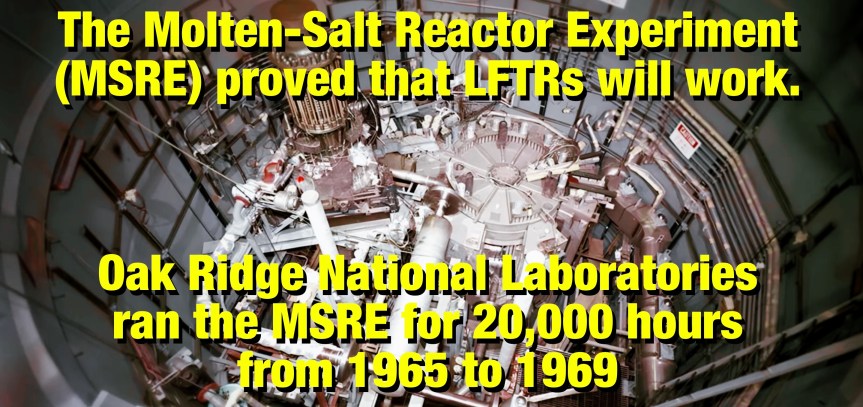
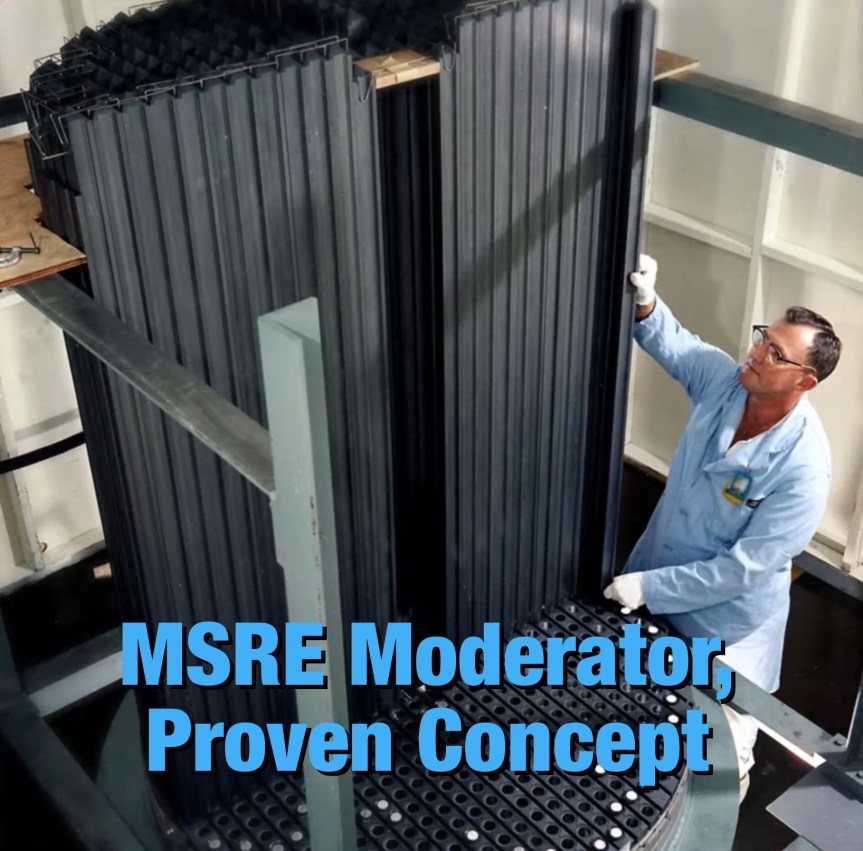
‘Made In The USA‘ — LFTRs are nuclear reactors that use thorium in a molten salt mixture (typically lithium fluoride salt or beryllium fluoride salt) as fuel, breeding uranium-233 to generate heat and electricity. Unlike LWRs, which operate under high pressure and rely on scarce uranium, LFTRs run at atmospheric pressure, the ordinary pressure in the air we breathe, eliminating explosion risks, and boast thermal efficiencies up to 45% (versus 32–36% for LWRs). Their two-fluid design—core fluid for power and blanket fluid for breeding new fuel—makes them self-sustaining, potentially producing up to 5% more fuel than they consume! Historical roots trace back to Oak Ridge National Laboratory’s (ORNL) Molten-Salt Reactor Experiment in the 1960s (click here for 21 min. mini-documentary from Oak Ridge), though thorium wasn’t fully utilized then. But ORNL built and ran the MSRE – Molten Salt Reactor Experiment from January 1965 to December 1969. LFTRs are literally ‘Made In The USA’!
(Article continues below video)
America’s Thorium Bounty
An LFTR’s thorium appetite is tiny. A 1 GW LFTR might need an initial charge of 12-15 tons of thorium, then just 1 ton per year as makeup fuel, thanks to breeding (based on ORNL MSBR designs and Flibe Energy estimates). With 440,000 tons, that’s enough to power 100 such reactors for over 4,000 years—or the whole U.S. grid (4,000 TWh/year) for centuries.
The U.S. sits on an estimated 440,000 metric tons of thorium reserves (although it’s probably considerably more), ranking it among the world’s leaders, according to the United States Geological Survey (USGS) and International Atomic Energy Agency (IAEA). Key deposits lie in:
- Idaho and Montana: High-grade veins in the Lemhi Pass district.
- Colorado: The Wet Mountains area.
- Florida: Placer deposits alongside rare earth minerals.
Thorium is often a byproduct of rare earth mining—currently a waste product miners pay to store—making it a virtually untapped resource. In contrast, uranium, fueling LWRs, is scarce domestically, with the U.S. importing 15% from Russia in 2023 alone. Thorium’s abundance offers a path to break this dependency, aligning with conservative priorities of self-reliance and economic strength.
Thorium deposits are likely to exist beyond the well-known fields in the US, particularly in areas with carbonatite rocks and monazite minerals, which are often rich in thorium. Major known deposits are in Idaho, Montana and Colorado, but there could be more in states like California, New Mexico and Georgia, where geological conditions are similar. Based on my extensive research, I would say the probability of finding new deposits is high, especially in unexplored carbonatite occurrences, as these can contain thorium in minerals like monazite.
Energy Potential: Powering a New American Golden Century
One single ton of thorium can produce the energy equivalent of approximately 3,96 million tons of coal, thanks to LFTRs’ extreme efficiency, producing about 3% more fuel than it burns. At full scale, America’s 440,000 tons of thorium could supply the nation’s energy needs for Centuries, slashing reliance on foreign fuels and bolstering energy security. Beyond electricity, LFTRs’ high operating temperatures (up to 700°C) support industrial applications like ammonia production and hydrogen generation, revitalizing manufacturing and creating jobs. This aligns with a vision of rebuilding the Economic Backbone: The American Middle Class through “dirt-cheap” energy—pun intended—while reducing the geopolitical leverage of adversarial suppliers, like Russia.
Advantages of LFTRs
LFTRs outshine LWRs across multiple dimensions:
Did you know that an average person would need about 3.26 ounces or 92.53 grams of thorium to cover ALL their residential electric power needs for an 80-YEAR LIFETIME in an LFTR, based on 12,000 kWh/year and the LFTR’s energy output of 4.716 billion watt-hours per pound?
And did you know such an amount of thorium would cost you less than $100 for a LIFETIME of Electric Energy!!?
We call that literally DIRT CHEAP ENERGY!
- Safety: Operating at neutral pressure, molten salt solidifies if leaked, preventing meltdowns and leaks. No Fukushima-style disasters here. An LFTR is ‘Walk-away Safe’.
- Efficiency: Higher thermal efficiency reduces fuel use and operational costs. LWRs use 0.7% of uranium’s potential. LFTRs use 100% of the fuel. Unlike LWRs that burn U-235 which in the US is 10 to 36 times more rare than Gold, LFTRs can actually breed more fuel than they’re burning, giving a virtually endless supply of energy through the fascinating mechanisms of nuclear physics.
- Energy Yield: One ton of thorium in an LFTR delivers energy equivalent to 200 tons of uranium in an LWR.
- Waste: LFTRs produce less long-lived radioactive waste, and can even burn existing LWR waste, addressing decades of nuclear cleanup challenges.
- Proliferation Resistance: Breeding uranium-232 with thorium emits gamma rays, making weapons-grade material all but impossible to extract or use—enhancing national security considerably.
- Cost: Simplified designs with fewer containment needs cut construction expenses significantly. LFTRs work at the same pressure as the atmosphere we breathe. They cannot blow up like an LWR.
- Lifespan: U.S. uranium reserves can fuel LWRs for a decade or two more at best without imports, and already the US imports 15% of the fuel from Russia.
Thorium powers LFTRs for millennia. Globally, uranium’s 30-100 years of supply looks shaky & exceedingly expensive against thorium’s near-infinite horizon.
These benefits make LFTRs a Conservative’s Dream: safe, domestic energy that drives prosperity without environmental baggage.

Challenges and Opportunities
Despite thorium’s promise, hurdles remain:
- Regulatory Barriers: The Nuclear Regulatory Commission (NRC) lacks LFTR-specific guidelines, slowing certification to less than a crawl.
- Funding: Development costs, estimated at $2.5 billion (2008 dollars), demand public-private investment. Some States have spend way more than that on useless, transient wind and solar.
- Public Perception: Nuclear fear lingers, though LFTRs’ extreme safety profile could shift opinions— 57% of Americans now favor more nuclear plants, up from 43% in 2020 (Pew Research Center).
Opportunities abound to overcome these:
Did you know that LFTR Reactors can burn long-lived waste from stockpiled LWRs? LFTRs can take current dangerous waste, which must be stored for 10,000 years and burn it, exploiting its energy potential and bring the stockpile down to a minuscule amount that is far less dangerous and only needs to be stored above ground for 300 years to be completely inert. Not only that! An LFTR can make 10 times more energy from waste, than the initial energy that was produced from the LWR that produced the waste!
- Private Innovation: Flibe Energy’s small modular LFTRs (20–50 MW) target rural and military markets, proving viability.
- Job Creation: A thorium economy would spur demand for engineers, miners, and manufacturers (e.g., graphite, nickel) to name but a few.
- Policy Push: Tax incentives and streamlined regulations, as seen in the Bipartisan Infrastructure Law, could provide the accelerated deployment needed to avoid being beat by Communist China.
Current Status in the U.S. — Pitiful
Flibe Energy, founded by Kirk Sorensen in Huntsville, Alabama, leads LFTR development, building on Oak Ridge Laboratory’s legacy. Their designs prioritize modularity for rural utilities and military bases for starters. The Department of Energy has funded related research (e.g., fluoride high-temperature reactors), but direct LFTR support is minimal. The Electric Power Research Institute (EPRI) analyzed Flibe’s design—the first fourth-generation reactor to earn this scrutiny—validating its potential. Still, federal backing lags, with no large-scale programs despite a U.S. goal to triple nuclear capacity by 2050.
Military Applications: An Unexpected Edge
Did you know that the element thorium was discovered in 1828 by Swedish chemist Jöns Jakob Berzelius? He identified it in a mineral sample from Norway, a land steeped in Norse mythology. Inspired by the region’s cultural heritage, Berzelius chose to honor Thor—known for his strength and association with thunder and lightning—reflecting the element’s own powerful potential, later realized in its radioactive and energy-producing properties. Berzelius announced the discovery and its name in 1829, linking the new element to the mythological might of Scandinavia’s legendary deity.
LFTRs could power military bases, enhancing grid resiliency and reducing reliance on vulnerable civilian infrastructure. Compact, safe, and self-sustaining, they align with Conservative Defense Priorities, offering energy independence for CONUS (Continental U.S.) operations. This military angle could catalyze broader adoption, driving down costs for civilian use and delivering literally “dirt-cheap electricity for everybody.”
Future Prospects and Policy Implications
LFTRs fit the U.S. nuclear expansion plan, but success hinges on action:
- Regulatory Reform: The Nuclear Regulatory Commission, NRC, must adapt to certify LFTRs efficiently. Could this be a job for DOGE?
- Investment: Public-private partnerships can bridge the funding gap. With so much wasted on the ‘feel-good’ transient energy sources wind and solar, there really shouldn’t be a gap, but unfortunately there is.
- Military Leadership: Defense contracts could jumpstart production, proving the technology commercially.
Renewables like solar (78% public support) and wind (72% public support) compete for attention, despite being extremely lousy sources of energy. LFTRs offer baseload reliability wind and solar can’t even dream of matching. A Trump Administration Thorium Initiative could leverage bipartisan nuclear support (e.g., Inflation Reduction Act) to secure this future.
The Trump Administration’s Golden Ticket
Uranium is a sinking ship—scarce, imported, and geopolitically risky.
Thorium, literally in America’s dirt, is the ace in the hole.
LFTRs promise energy independence, thousands — maybe even millions — of jobs, and a middle-class revival, all while leaving foreign suppliers in the dust.
A Thorium Energy Initiative could be Trump’s legacy:
- national defense strengthened,
- economic growth unleashed,
- and abundant electricity for all.
And with Communist China looming large in the East, it’s time to stop burning through uranium’s finite “gold” and mine the future!
Conclusion and Recommendations
LFTRs are America’s path to a secure, prosperous energy future. To get there:
- Fund Innovation: Allocate federal grants and loan guarantees to companies like Flibe Energy.
- Streamline Regulations: Update NRC frameworks for LFTR certification as soon as possible.
- Leverage the Military: Deploy LFTRs on military bases to prove viability and scale up.
- Educate the Public: Highlight safety and economic wins to build support.

According to Chris Martenson, PhD, in his book The Crash Course, the size of a nation’s economy is closely and positively correlated to the amount of extracted hydrocarbon used in that economy — because generated energy is the substitute for labor.
Why hydrocarbons? Because they are energy dense. However, research suggests thorium in a Liquid Fluoride Thorium Reactor (LFTR) is about 4 million times more energy dense than coal in terms of electrical energy output, based on typical power plant efficiencies (45% for LFTR, 35% for coal).
So, if we are to bootstrap ourselves through the Fourth Industrial Revolution in an American way, one that creates abundance for everyone, not crushes people underfoot with scarcity so that only few can benefit, we must understand that we are reaching the limits of what available hydrocarbons can do for us.
With enough support to push LFTR Reactors out on the market, hydrocarbon resources can be stretched much longer in areas where nuclear energy is impractical, such as fuel for passenger aircrafts or hydrocarbon fueled engines for both military and civilian applications. In other words, flying will be cheaper in the future because hydrocarbon fuels used for power generation can then be used in areas where nuclear power can’t be used.
If we are to power the next 50 years of Economic Growth, we must accept that our fuels blend must change more to nuclear, and the most efficient nuclear fuel we are able to deploy right now is thorium by an order of magnitude. In fact the size and modularity of thorium tractors can help eliminate one of the greatest vulnerabilities in our economy, the too few points of critical failure in our electric infrastructure. Thorium reactors can be deployed to create village-scale microgrids, making modern technological American civilization more robust and resilient.
With 440,000 tons of thorium waiting, the U.S. can lead the world in nuclear innovation—again. Act now, and we don’t have to wait until 2050 for literally “dirt-cheap” energy to power a new American Golden Age!
Fact Box: Thorium vs. Uranium
| Aspect | Thorium (LFTRs) | Uranium (LWRs) |
|---|---|---|
| Abundance (U.S.) | 440,000 metric tonnes (centuries of supply) | Limited (15% imported from Russia). One, possibly two decades left. U-235 is 10 to 36 times more rare than Gold! |
| Fuel | Thorium (breeds Uranium-233, and can theoretically add 5-7% more fuel than it actually burns, realistically it will be more like 1-3%, (Breeding Ratio, ~BR≥1.02) making LFTRs an endless energy resource. 1 ton of thorium is the equivalent of 3,96 million tons of coal.) | Uranium 235 (Breeding Ratio, BR Range 0.5 to 0.6, meaning it breeds only about half as much fuel as it burns. In an LWR with optimized neutron moderation, 1 ton of enriched uranium fuel (~4% U-235) is the equivalent of 570,000 tons of coal. In pure form, 1 ton U-235 is the energy equivalence of 1.52 million tons of coal) |
| Safety | Inherent, no meltdown risk. In case of emergency, a salt plug in the bottom of the reactor melts, draining the salt into cooling tanks, where the salt cools and solidifies. | High-pressure, requires extensive containment needed. Risk of meltdown, steam explosions & hydrogen-oxygen explosions. |
| Efficiency | Up to 45% Doesn’t need to be shut down. The fuel is liquid and is added continuously. | 32–36% Must be shut down periodically for longer periods to refuel. |
| Waste | Significantly less long-lived waste. LFTRs can even burn waste from LWRs, stockpiled for decades! | LWRs make more long-lived waste, cannot burn any waste. LWRs have filled waste deposits with extremely long-lived waste for many decades. |
| Proliferation Risk | Very Low. U-232 lethal gamma rays makes U-232 unusable in weapons. Thus, reactors can be sold to foreigners, spawning a whole new, very lucrative, export market. | Very high Any Nation with Light Water Reactors are already 85% of the way to making Nuclear Weapons. All you need for the last 15% to get to a bomb is a Plutonium-239 Reprocessing Plant from spent fuel, or simply enrich Uranium-235 Fuel to above 60% U-235. A U-235 bomb doesn’t need Weapons Grade (>90% U235). Highly Enriched Uranium-235 (>60%) is enough. |
Sources: USGS, IAEA, OSTI.GOV, Energy From Thorium
Table: Comparison of U.S. and China Thorium Reactor Development
| 🇺🇸 United States | 🇨🇳 China | |
|---|---|---|
| Current Status | Research and private development (e.g., Flibe Energy), limited federal support, no operational thorium reactor, endless NRC red tape | TMSR-LF1 (uranium) operational since 2019, TMSR-LF2 (thorium) under construction, criticality expected 2026 |
| Reactor Design | LFTR (Lithium Fluoride Thorium Reactor), molten salt | TMSR (Thorium Molten Salt Reactor), lithium fluoride-based, molten salt |
| Funding | Sparse, reliant on private sector, regulatory hurdles | Significant state-backed investment, aggressive timeline |
| Thorium Reserves | Estimated 440,000 tons, largely untapped | Significant domestic reserves, part of energy strategy |
| U.S.-Educated Talent | Developing domestically, some researchers educated abroad | Several key engineers (e.g., Hong Li, Ding Benru) with U.S. PhDs |
This table, derived from World Nuclear Association reports and SINAP project updates, highlights the competitive landscape and underscores the urgency for U.S. action.
How Uranium-232 influenced the Pathway of Thorium Reactors
LFTR Reactors will provide the necessary Radioisotopes to revolutionize Cancer Treatment with Targeted Alpha Therapy
Key Citations
- China’s Nuclear Fuel Cycle World Nuclear Association
- TMSR Project Updates Chinese Academy of Sciences
- Advantages of Liquid Fluoride Thorium Reactor OSTI
- Flibe Energy Stakeholders Flibe Energy Flibe Energy company focus and military applications
- U.S. Nuclear Energy Industry Evolution Department of Energy
- China’s Nuclear Research Collaborations CSIS
- LFTR Overview – Energy From Thorium detailed explanation
- Documentary (20:31) produced in 1969 by Oak Ridge National Laboratory for the United States Atomic Energy Commission to inform the public regarding the History, Technology, and Milestones of the Molten Salt Reactor Experiment (MSRE)
- YouTube channel gordonmcdowell – the biggest collection of thorium reactor & related lectures
- Liquid Fluoride Thorium Reactor (LFTR) Preliminary Safeguards Assessment, Flibe Energy detailed report
- The LFTR in the American Scientist | Energy Central safety features discussion
- Should We Consider Using Liquid Fluoride Thorium Reactors for Power Generation? | Environmental Science & Technology thorium reserves
- Is the US pursuing the liquid fluoride thorium reactor as a power source? – Quora government funding insights
- Thorium Energy Alliance
- Copenhagen Atomics
- Not So Fast with Thorium | American Scientist regulatory challenges
- The LFTR, How much will it cost? | Energy Central cost estimates
- Downsides of LFTRs – Molten Salt Reactors public perception issues
- 5 Ways the U.S. Nuclear Energy Industry Is Evolving in 2024 | Department of Energy policy support
- U.S. Sets Targets to Triple Nuclear Energy Capacity by 2050 | Department of Energy future targets
- Majority of Americans support more nuclear power in the US | Pew Research Center public opinion
- Advantages of liquid fluoride thorium reactor in comparison with light water reactor | OSTI.GOV technical comparison
- Flibe Energy Inc. – Summary from LegiStorm EPRI study details
- Liquid fluoride thorium reactor – Wikipedia comprehensive overview

![BREAKING NEWS – PROVEN: BIDEN IS A TRAITOR! GAVE $160 BILLION TAX MONEY FROM AMERICANS TO IRAN! [VIDEO included]](https://norwayfortrump.com/wp-content/uploads/2026/03/joe-biden-160-billion-tax-dollars-to-enemy-iran.jpg?w=1024)
![BREAKING: 3 U.S. SERVICE MEMBERS HAVE FALLEN — PRESIDENT TRUMP REMARKS [VIDEO]](https://norwayfortrump.com/wp-content/uploads/2026/03/3-americans-fallen.jpg?w=1024)

Leave a comment